
Indication
Maximum rapid and pronounced enlargement of the pupil.
Prevention of the development of uveitis or the destruction of sinechias with uveitis.
Enlargement of the pupil before intraocular surgical intervention.
Medicinal form
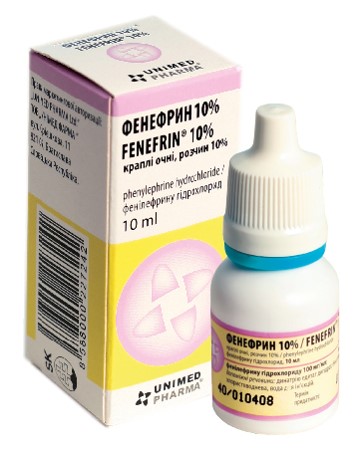
Eye drops, solution.
Composition of the substance
active substance: phenylephrine hydrochloride; 1 ml of solution contains phenylephrine hydrochloride 100 mg; 1 ml contains 38 drops;
excipients: disodium edetate, benzalkonium chloride, hydrochloric acid diluted acid, water for injection.
Pharmacological properties
Pharmacodynamics.
Phenylephrine, as an ophthalmic drug, is used locally at concentrations of 0.06% to 10.0% to achieve the effect of vasoconstriction in concentrations of 0.1-0.25%.
Phenylephrine hydrochloride belongs to the group of preparations of alpha-1-sympathomimetics with pronounced antihyperemic effect. The ability of phenylephrine to expand the pupil is associated with the activation of the alpha-1 receptors on the muscle that extends the pupil and is partially responsible for reducing intraocular pressure after the administration of phenylephrine hydrochloride at high concentrations (2.5 ą 10%). The vasoconstrictive effect is achieved and is shown to be an anti-edema effect on the mucous membrane of the nose and conjunctiva with their hyperemia, despite the application of a solution of low-concentration phenylephrine. After instillation of 10% solution of phenylephrine hydrochloride in some cases there was a development of paralysis of accommodation, as well as mydriasis. But there is evidence that a 10% solution causes maximal pupil enlargement within 20 minutes without the development of paralysis of accommodation. The pupil’s enlargement effect lasts about 5 hours. Proved relationship between dose (or concentration) and exposure to accommodation (or pupil dilatation) in the form of enhancement of effect at concentrations of 0.1 to 10.0% on pupil size and intraocular pressure. A solution of 0.125% concentration does not affect pupil size and intraocular pressure.
Pharmacokinetics.
Epithelium of the cornea plays an important role in the metabolism of phenylephrine. After removing the epithelium of the cornea, the penile penile protein and its metabolites increase by about 10 times, because phenylephrine is poorly soluble in fats and, at physiological parameters, pH has the properties of a weak alkali. Phenylephrine is also partially metabolised in the corneal tissues. The concentration of phenylephrine in the eye is significantly reduced due to metabolism, if the concentration of the conjunctival sac contained in the solution was less than 0.1%.
Producer
«UNIMED PHARMA Ltd».
Location of the manufacturer and the address of the place of its operation
Orieskova 11, 821 05 Bratislava, Slovak Republic.